How to choose accounting software for a shop in Iraq (2026)
What to check before paying for accounting software for an Iraqi shop: double entry, the cashier, the dinar, language, debts, your accountant and the real yearly price.
The Dashing teamUpdated 5 min read
"Accounting software" means two different things to a shop owner and to an accountant. The owner wants to know profit, debts and cash without learning accounting; the accountant wants a journal, a trial balance and statements they can defend. Few systems serve both, and most guides online are written for markets with VAT and e-invoicing, which Iraq does not have today.
We are the Dashing (داشنك) team, so we make accounting software ourselves. This guide names no products. It lists what to check, what to ask a vendor, and how Dashing answers each point, including where it falls short.
The kinds of software you will meet
- Desktop accounting programs: installed on one Windows machine, well known to many accountants, usually sold through a local agent. Backups are your job, a second branch is a second installation, and the cashier is a separate program.
- Local Iraqi vendors: cashier, stock and accounting in one plan, often working without internet, with support in Baghdad. Prices on vendor pages in September 2026 started around 90,000 IQD a year, with a monthly fee for each extra branch.
- Arabic cloud accounting services: invoicing, accounting and stock in the browser, built mostly around Gulf VAT and e-invoicing. Typical yearly prices on vendor pages were $240 to $660, in dollars, with invoice caps on the cheaper plans.
- Global cloud accounting: deep reports and a network of certified accountants, usually English first and priced in dollars. Some have a free plan with a yearly invoice cap (about 1,000 invoices); paid plans for one user ran from about $120 to $456 a year, and more with two users. Most have no cashier.
- Per-user ERP suites: accounting inside a full business suite, priced per user with an implementation partner. About $174 to $215 a year for two users before implementation, and setup is the real work.
- Dashing: cashier, stock and accounting in one system, Arabic first, with Kurdish and English.
Prices come from vendor pages we read on 14 and 27 September 2026 and will have moved; check before you decide.
What to check
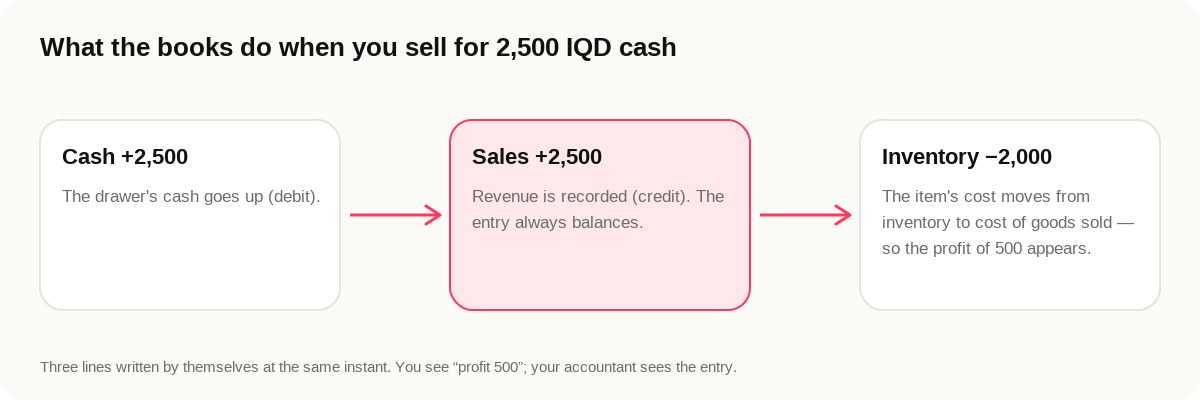
- Real double entry. Ask for the income statement and balance sheet during the trial. They must come from the same data the cashier enters, not from an exported file. In Dashing every sale, purchase, expense and collection becomes a double-entry journal entry automatically.
- Cashier and stock in the same system. Otherwise accounting starts with manual entry every evening. Dashing's cashier, stock and books are one system.
- The dinar. Whole dinars with no fractions, and dollar pricing when you need it. Dashing keeps the dinar whole. It cannot keep books in two currencies at once.
- Arabic and Kurdish. For the owner and the accountant together. Dashing is Arabic first with Kurdish and English; many foreign products translate Arabic and skip Kurdish.
- Customer and supplier debts. Aging, statements and credit limits. Dashing has all three.
- What your accountant understands. Can the accountant open the journal and trial balance themselves? In Dashing they are in the same Accounting section as the owner's plain-language profit and debts. If your accountant only works in one familiar program, ask them before you switch.
- Price for your real setup. A one-branch shop with two users, per year. Ask about per-user fees, per-branch fees, invoice caps and what is charged in dollars. Dashing is free for one branch with its full accounting, or 420,000 IQD a year per shop for more branches and Dash at 40 messages a day, with no per-user fees. See pricing.
We did not count e-invoicing and tax-authority links, because Iraq has neither today (the cashier software guide explains the situation).
Questions to ask any vendor
- Can I see the income statement and balance sheet in the trial, built from real sales?
- Can I export all my data, in a format I can open without you?
- Who does the backups, and where do they live?
- What happens to my price when I add a second branch or a third user?
- Does it work when the internet drops, and does the cashier upload its sales when it returns?
- Can I import my old journal entries, or do I start from opening balances? (Dashing starts from opening balances.)
- Who answers when something breaks, in which language, and how fast?
What Dashing does not do
- No payroll and no automatic bank connection.
- No e-invoicing.
- No books in two currencies at once, and no import of old journal entries from another program.
- No restaurants with tables and kitchen screens.
- It is a young product. If you need a vendor with twenty years of history, weigh that honestly.
What about Excel?
Excel is not accounting software, but it is what most shops actually use. It works as long as one person enters everything every day, and stops at the first second employee, second branch or busy month. If you stay on Excel, two free tools on this site cover what customers and suppliers ask you for: a statement of account with the balance after every entry, and an invoice generator that prints the invoice or saves it as a PDF.
How to choose
- A shop without a full-time accountant: pick a system that books by itself from the cashier, so nobody types a number twice.
- A company whose accountant works in one desktop program: keep it if the books are licensed and backed up, and ask who does the backups.
- A Gulf entity or Gulf e-invoicing: choose an Arabic cloud service built for it.
- An international accountant or a foreign investor: a global cloud service may be what they ask for.
- A company with an implementation budget: a per-user ERP suite.
Found an error or an outdated figure? Message us and we will correct it, with the date.
Related reading: An accounts program for a shop: what you need, and what is sold to you and Retail software in Iraq, 2026: the market, the options, what to expect.
Sources
- Dashing pricing, https://dashingerp.com/en/pricing (accessed 2026-10-21)
- Category price ranges: vendor price pages read on 2026-09-14 and 2026-09-27; figures change, so check current pages.
This article is also available in العربية · کوردی